| |
|
|
LAI MUSEUM

|
| |
|
|
| |
|
|
| |
|
|
| |
|
|
| |
|
|
| |
|
|
| |
|
|
| |
|
|
| |
|
|
| |
|
|
| |
|
|
| |
|
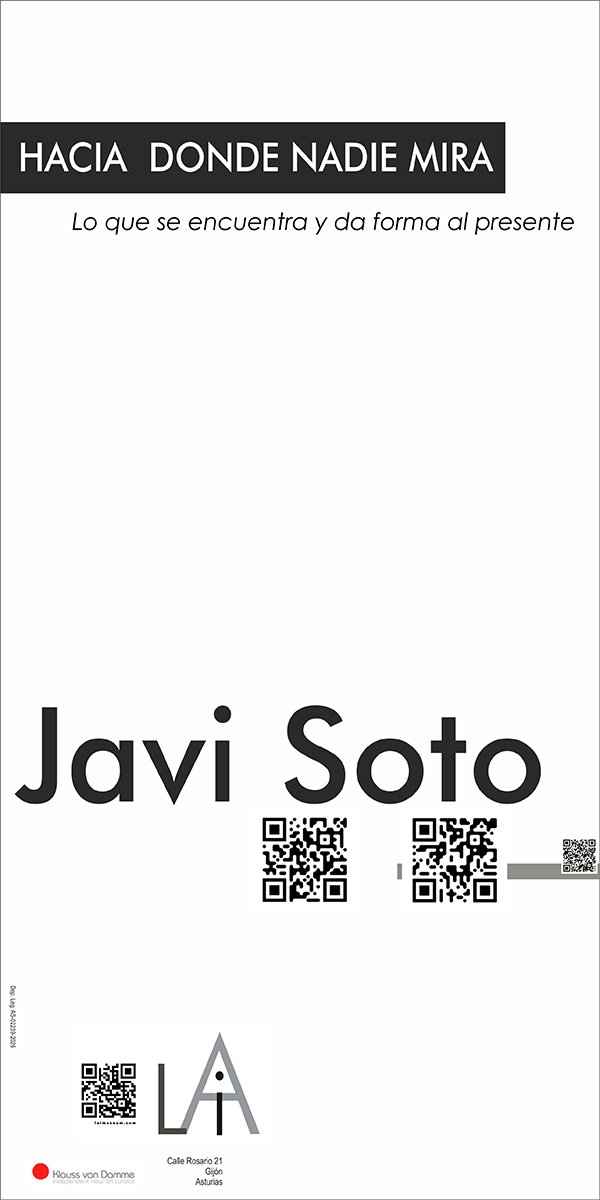
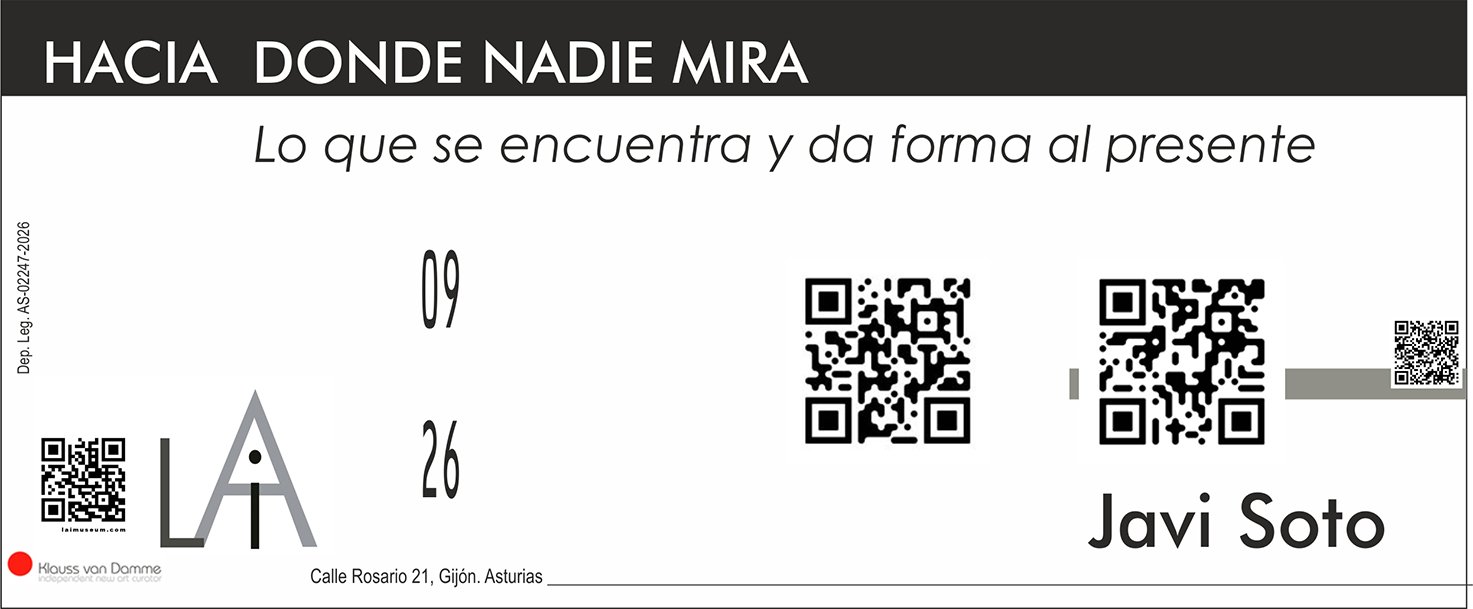
HACIA DONDE NADIE MIRA. Lo que se encuentra y da forma al presente
Javi Soto
|
|
| |
|
Septiembre 2026
_ intervención espacial _ |
|
| |
|
_ instalación específica _ exposición concebida para un espacio visible exclusivamente desde una ventana _
|
 |
| |
|
|
|
| |
|
|
|
| |
|
|
|
| |
|
|
|
| |
|
|
|
| |
|
“Hacia donde nadie mira. Lo que se encuentra y da forma al presente” es una intervención site-specific concebida para un espacio cuya única posibilidad de contemplación se produce desde el exterior. El cristal de la ventana deja de ser un límite arquitectónico para convertirse en un dispositivo de mediación que determina la experiencia de la obra. El espectador nunca accede al interior; permanece frente a una escena inaccesible donde la distancia física se convierte también en distancia conceptual. |
|
| |
|
|
|
| |
|
La instalación investiga aquello cuya existencia depende de unas circunstancias determinadas y, por tanto, es necesariamente temporal. Las piezas de esta instalación desarrollan su funcionalidad como articulación o punto de unión entre distintos elementos. |
|
| |
|
|
|
| |
|
La esquina del espacio expositivo, el soporte improvisado que mantiene estable la mesa y el punto de tangencia de la composición geométrica constituyen tres formas de entender una misma idea: la estabilidad no como una condición permanente, sino como el resultado de una relación entre fuerzas, apoyos y articulaciones. |
|
| |
|
|
|
| |
|
|
|
| |
|
La instalación desplaza deliberadamente la atención hacia aquello que normalmente permanece fuera del campo de la mirada: los mecanismos que sostienen las estructuras, las prótesis que compensan sus fracturas y los puntos de unión donde se hace visible su fragilidad. |
|
| |
|
|
|
| |
|
|
|
| |
|
En este sentido, el título “Hacia donde nadie mira. Lo que se encuentra y da forma al presente” no describe las obras; propone un desplazamiento de la mirada. No indica qué mirar, sino hacia dónde dirigir la atención. |
|
| |
|
|
|
| |
|
|
|
| |
|
|
| |
|
|
| |
|
|
| |
|
|
| |
|
|
| |
|
|
| |
|
|
| |
|
|
| |
|
|
| |
|
|
| |
|
|
|
| |
|
OBRAS |
|
| |
|
|
| |
1. COYUNTURAL |
| |
|
Pintura acrílica sobre tela |
| |
|
700 × 200 cm |
| |
|
|
| |
|
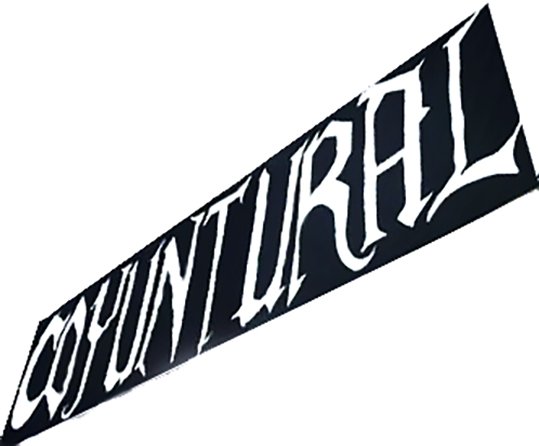
Gran pancarta de lona negra pintada manualmente con la palabra COYUNTURAL |
| |
|
|
| |
|
El término procede del latín coniunctura, cuyo significado original hacía referencia a una articulación: el punto donde dos elementos se unen. Posteriormente pasó a designar la convergencia de circunstancias que producen una situación determinada y, por extensión, todo aquello cuya existencia depende de factores temporales y cambiantes.
|
|
| |
|
|
| |
|
Su definición incorpora tres dimensiones fundamentales: |
| |
|
|
| |
|
|
| |
|
• Temporalidad: existe únicamente mientras permanecen las circunstancias que la originan. |
| |
|
|
| |
|
• Dependencia: su estabilidad está condicionada por la convergencia de múltiples factores. |
| |
|
|
| |
|
• Oposición a lo estructural: frente a aquello que permanece, lo coyuntural designa lo provisional, lo contingente y lo mutable. |
| |
|
|
| |
|
|
| |
|
|
| |
|
 |
| |
|
Instalada sobre paredes contiguas, la pieza convierte la esquina en una articulación arquitectónica. El lenguaje abandona su condición exclusivamente textual para adquirir una dimensión espacial y escultórica. |
| |
|
|
| |
|
|
| |
|
|
| |
|
|
| |
|
|
| |
| |
| |
| |
| |
| |
| |
|
|
| |
|
 |
| |
|
2. MESA COJA _ © JAVI SOTO 2026 |
| |
|
|
| |
|
Escultura |
| |
|
|
| |
|
Mesa de madera. |
| |
|
100 × 77 × 71 cm |
| |
|
|
| |
|
Soporte metálico para fluorescentes. |
|
| |
|
120 × 10 x12 cm |
|
| |
|
|
|
| |
|
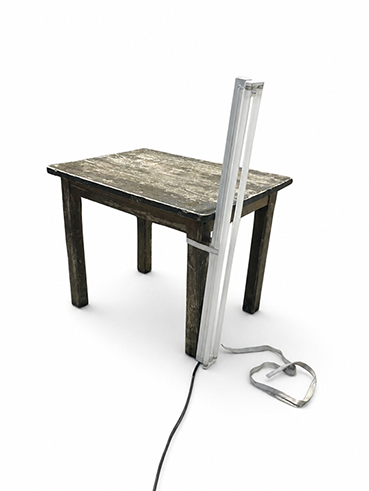
Mesa con una de sus patas acortada cuya estabilidad depende de un soporte metálico para dos tubos fluorescentes encendidos, fijado mediante una cincha y utilizado como pata sustitutoria. |
|
| |
|
|
| |
|
La pieza transforma un sistema de iluminación en un elemento estructural. No plantea una reparación, sino una compensación. La fractura continúa existiendo; únicamente ha sido desplazada mediante una solución provisional. |
|
| |
|
|
| |
|
El soporte no deja de iluminar para sostener. |
| |
|
|
| |
|
|
| |
|
|
| |
|
|
| |
|
|
| |
|
|
| |
|
|
| |
|
|
| |
|
|
| |
|
|
| |
|
 |
| |
|
3. IMAGEN NUCLEAR |
| |
|
|
| |
|
Composición geométrica (código QR) |
| |
|
|
| |
|
Impresión pigmentaria. |
| |
|
|
| |
|
Composición abstracta en blanco y negro construida mediante cuatro campos curvos definidos por arcos de circunferencia que convergen en un único punto de tangencia. La organización radial genera una estructura basada en el equilibrio entre figura y fondo, el contraste cromático absoluto y la tensión entre las formas. |
|
| |
|
|
| |
|
|
| |
|
La imagen, reduce el proyecto a su mínima expresión formal. No representa un objeto, sino una relación. Toda la tensión se concentra en un punto donde cuatro fuerzas encuentran un equilibrio simultáneamente estable y precario. No hay centro, no hay jerarquía y no hay objeto…Sólo existe una articulación. Funciona como síntesis visual del proyecto y cómo identidad gráfica de la exposición. Sería el equivalente a un logotipo, pero sin ser un logotipo comercial: un signo conceptual que condensa toda la investigación. |
|
| |
|
|
| |
|
Sería el símbolo del proyecto. |
| |
|
|
| |
|
|
| |
|
|
| |
|
|
| |
|
|
| |
|
|
| |
|
|
| |
|
|
| |
|
|
| |
|
|
| |
|
|
| |
|
|
| |
|
|
| |
|
|
| |
|
|
| |
|
|
| |
|
|
| |
|
|
| |
|
|
| |
|
|
| |
|
|
|
| |
|
WHERE NO ONE LOOKS. What Is Found and Shapes the Present
Javi Soto
SEPTEMBER _ OCTOBER 2026
|
| |
|
|
| |
|
|
| |
|
“Where No One Looks. What Is Found and Shapes the Present" is a site-specific installation conceived for a space that can only be viewed from outside. The window ceases to function as an architectural boundary and becomes a mediating device that shapes the experience of the work. Visitors are never able to enter the space; instead, they remain before an inaccessible scene in which physical distance also becomes conceptual distance. |
|
| |
|
|
| |
The installation investigates that which exists only under specific circumstances and is therefore inherently temporary. Each work functions as a point of articulation, establishing relationships between different elements. |
|
| |
|
|
| |
The corner of the exhibition space, the improvised support that stabilizes the table, and the point of tangency within the geometric composition each embody the same principle: stability is not a permanent condition, but the result of relationships between forces, supports, and articulations. |
|
| |
|
|
| |
The installation deliberately shifts attention toward what usually remains outside the field of vision: the mechanisms that sustain structures, the prostheses that compensate for their fractures, and the joints where their fragility becomes visible. In this sense, the title Where No One Looks. What Is Found and Shapes the Present does not describe the works; it proposes a shift in perception. It does not indicate what to look at, but where to direct one's gaze. |
|
| |
|
|
| |
|
|
| |
|
|
| |
|
|
| |
WORKS
1. COYUNTURAL
Acrylic on canvas
700 × 200 cm
|
|
| |
|
|
| |
A large black canvas banner hand-painted with the word COYUNTURAL. |
|
| |
|
|
| |
The term derives from the Latin coniunctura, originally referring to a joint or articulation—the point where two elements meet. It later came to designate the convergence of circumstances that produce a particular situation and, by extension, everything whose existence depends on temporary and changing conditions. |
|
| |
|
|
| |
Its definition comprises three fundamental dimensions: |
|
| |
|
|
| |
• Temporality: it exists only as long as the circumstances that give rise to it remain.
• Dependence: its stability is conditioned by the convergence of multiple factors.
• Opposition to the structural: in contrast to that which endures, the conjunctural designates what is provisional, contingent, and mutable. |
|
| |
|
|
| |
Installed across two adjoining walls, the work transforms the corner of the gallery into an architectural articulation, where language extends beyond its textual function toacquire a spatial and sculptural presence. |
|
| |
|
|
| |
|
|
| |
|
|
| |
2. LIMPING TABLE |
|
| |
Sculpture |
|
| |
|
|
| |
Wooden table
100 × 77 × 71 cm |
|
| |
|
|
| |
Metal fluorescent light fixture
120 × 10 × 12 cm |
|
| |
|
|
| |
A table with one deliberately shortened leg is stabilized by a metal support designed to hold two illuminated fluorescent tubes, secured with a strap and used as a substitute leg.
|
|
| |
|
|
| |
The work transforms a lighting system into a structural element. It does not propose a repair but a compensation. The fracture remains; it has merely been displaced through a provisional solution. |
|
| |
|
|
| |
The support never ceases to illuminate in order to sustain. |
|
| |
|
|
| |
|
|
| |
|
|
| |
|
3. NUCLEAR IMAGE |
| |
|
Geometric composition (QR code) |
| |
|
|
| |
|
Pigment print |
| |
|
|
| |
|
An abstract black-and-white composition constructed from four curved fields defined by arcs of circles converging at a single point of tangency. The radial organization creates a structure based on the balance between figure and ground, absolute chromatic contrast, and the tension between forms. |
|
| |
|
|
|
| |
|
The image reduces the project to its most elementary formal expression. It represents not an object but a relationship. All tension is concentrated at a single point where four forces achieve an equilibrium that is simultaneously stable and precarious. There is no centre, no hierarchy, and no object—only an articulation. |
|
| |
|
|
|
| |
|
The work functions as the visual synthesis of the project and as its conceptual identity: the equivalent of a logo, yet without any commercial purpose—a conceptual sign that condenses the entire research. |
|
| |
|
|
|
| |
|
It serves as the symbolic image of the project. |
|
| |
|
|
|
| |
|
|
|
| |
|
|
|
| |
|
|
|
| |
|
|
|
| |
|
salalai _ calle rosario 21, Gijón _ Asturias _
|
|
| |
|
|
|
| |
|
|
|
| |
|
|
|
| |
|
|
|
| |
|
|
|
| |
|
|
|
| |
|
|
|
| |
|
|
|
| |
|
|
| |
|
|
| |
|
|
| |
|
|
| |
|
|
| |
|
|
| |
|
|
| |
|
|
| |
|
|
| |
|
|
| |
|
|
| |
|
|
| |
|
|
| |
|
|
| |
|
|
| |
|
|
| |
|
|
| |
|
|
| |
|
|
| |
|
|
| |
|
|
| |
|
|
| |
|
|
| |
|
|
| |
|
|
| |
|
|
| |
|
|
| |
|
|
| |
|
|
| |
|
impresos artísticos |
| |
[ + ] CARTEL |
| |
[ + ] TARJETÓN |
| |
| |
|
Javi Soto _ about _
|
| |
|
|
| |
|
|
| |
|
|
| |
|
|
| |
|
_ créditos _colaboraciones _ agradecimientos _ salalai |
| |
|
asistencia técnica: DAVID MARTÍNEZ SUÁREZ |
| |
producción vinilográfica: Senda Color |
| |
| |
fotografía: NOÉ BARANDA FERRERO |
| |
comisrariado artístico:. Klauss van Damme  |
| |
|
|
| |
|
|
| |
|
|
| |
|
|
| |
|
|
| |
|
|
| |
|
|
| |
|
|
| |
|
|
| |
|
|
| |
|
|
| |
|
|
| |
|
|
| |
|
|
| |
|
|
| |
|
|
| |
|
|
| |
|
|
| |
|
|
| |
|
|
| |
|
|
| |
|
|
 laimuseumlFONDO DOCUMENTAL DE ARTE ACTUAL _ registro artístico _ laimuseumlFONDO DOCUMENTAL DE ARTE ACTUAL _ registro artístico _
|
Advertencia.- Toda documentación y contenido de este sitio web está disponible exclusivamente para visualización y/o consulta telemática y está protegido por la Ley de la Propiedad Intelectual. La copia, descarga, manipulación, ocomunicación pública o cualquier otro uso de la totalidad o parte de www.laimuseum.com requiere autorización previa y/o licencia de uso, en su caso, sea cual fuere la finalidad y el medio, inventado o por inventar Registro artístico y compilación web autoral realizados por Begoña Muñoz Fernández. Reservados Todos los Derechos / All Rights Reserved (vegap) |
| |
|
|
|
|
|
|
|
|
|
@laimuseum |
| |
 |
| |
|
|
|
|
|
|
|
|
|
<<< Volver / Back to the INDEXsite |
|
Powered by & Cº Ed.

|